AI understands you,
and verified engines guarantee the accuracy.
lifeGmap is an AI health platform that connects the exercise, nutrition, recovery, and pain signals of users over 40 and turns them into an actionable weekly health-habit plan. Multiple AI agents read and interpret the data to design each day and week, while figures such as intensity and scores—and every safety decision—are guaranteed by verified deterministic engines and a knowledge graph.
Already invited? Go to the app →We don't keep a workout app, a diet app,
and a pain-logging app apart.
Whether an elevated heart rate comes from fatigue, lack of sleep, meal timing, or pain avoidance—you have to look at it together. lifeGmap gathers your life signals onto one platform and condenses the next action into a single daily and weekly experience.
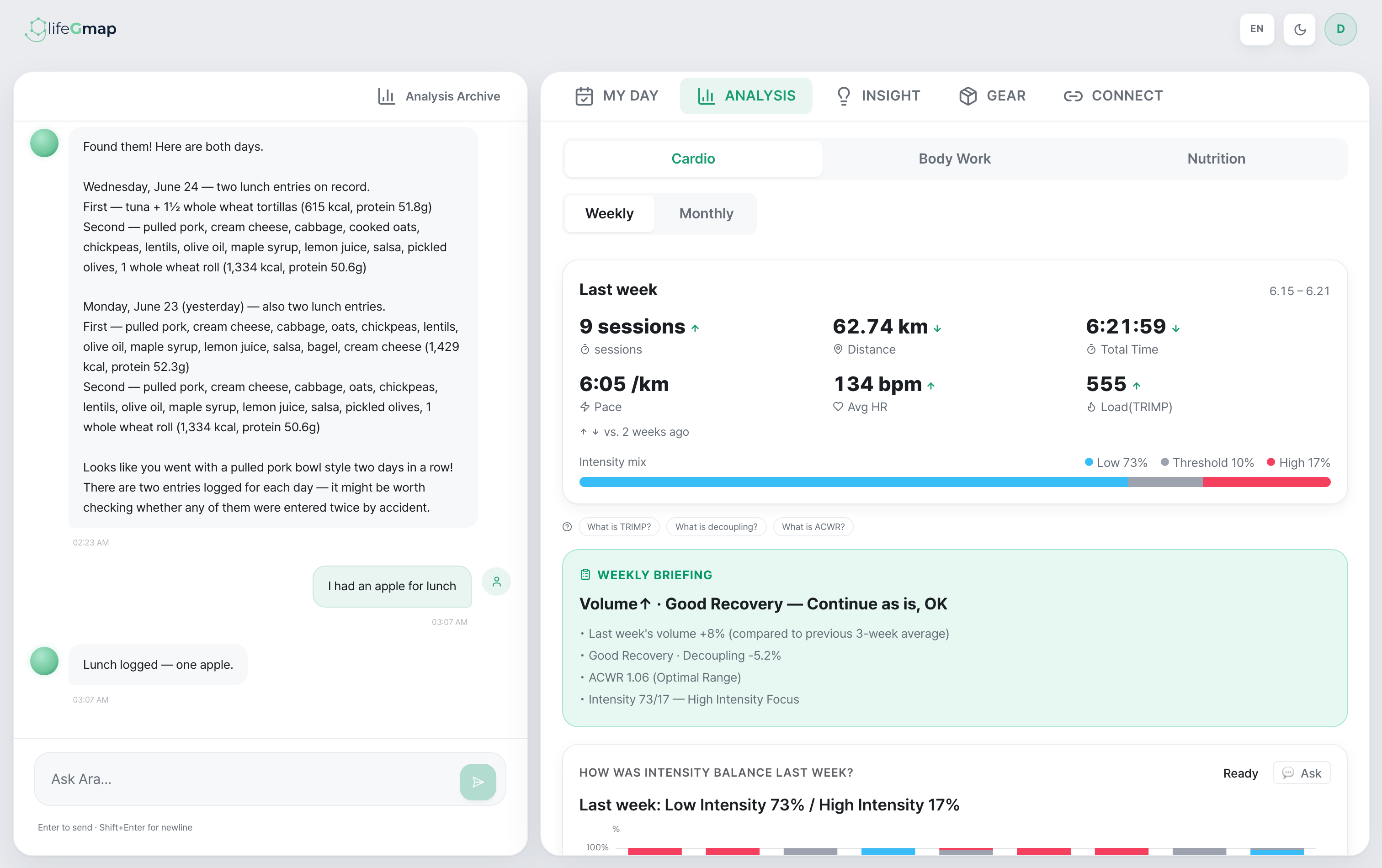
The signature 2-pane — Ara chat on the left, ANALYSIS (Cardio Weekly · HR zones · ACWR) on the right, all on one screen.
Heart rate · Zone · Pace · Indoor bike
Metabolic flexibility · Cardiorespiratory endurance
Strength · Stretching · Rehab support (171 movements)
Muscle-loss prevention · Joint stability
Natural-language meals · Protein · Hydration · Micronutrients
Recovery and eating habits matched to training load
Pain location · Intensity · RPE · Recovery status
Overtraining · Repeat-injury prevention
Conversation context · Schedule · Travel · Fatigue signals
Plan adjustments · Habit consistency
The LLM speaks.
Calculation and state changes are done by deterministic engines.
In health tech, it is dangerous to let an LLM generate numbers directly or finalize plans. So the LLM is used only for intent understanding, explanation, conversation, and structured extraction, while intensity, scores, safety limits, and plan finalization are handled by Python deterministic engines. In particular, no LLM is used at all to generate the weekly plan — the same input always yields the same output.
This is our neuro-symbolic design — neural language for understanding and explanation, symbolic engines for facts, decisions, and safety.
We don't reason about what we don't know.
Every coaching rationale comes from the knowledge graph.
Physiology, musculoskeletal, and nutrition knowledge are connected as a graph, and we answer only what has academic grounding. Even queries generated by the LLM run only if they pass a safety guard.
Three domains (physiology, musculoskeletal, nutrition) connected by 23 Constraints based on scientific literature.
Fitness tier F1–F5 × health context H1–H4, plus CONTRAINDICATED_WITH — this exercise is forbidden for this injury.
CypherGuard: always enforces a user_id entry point · LIMIT ≤ 100 · every query is logged. OKF knowledge catalog of 35+ cards.
Real-time coaching is harder than post-workout analysis.
That's exactly what sets us apart.
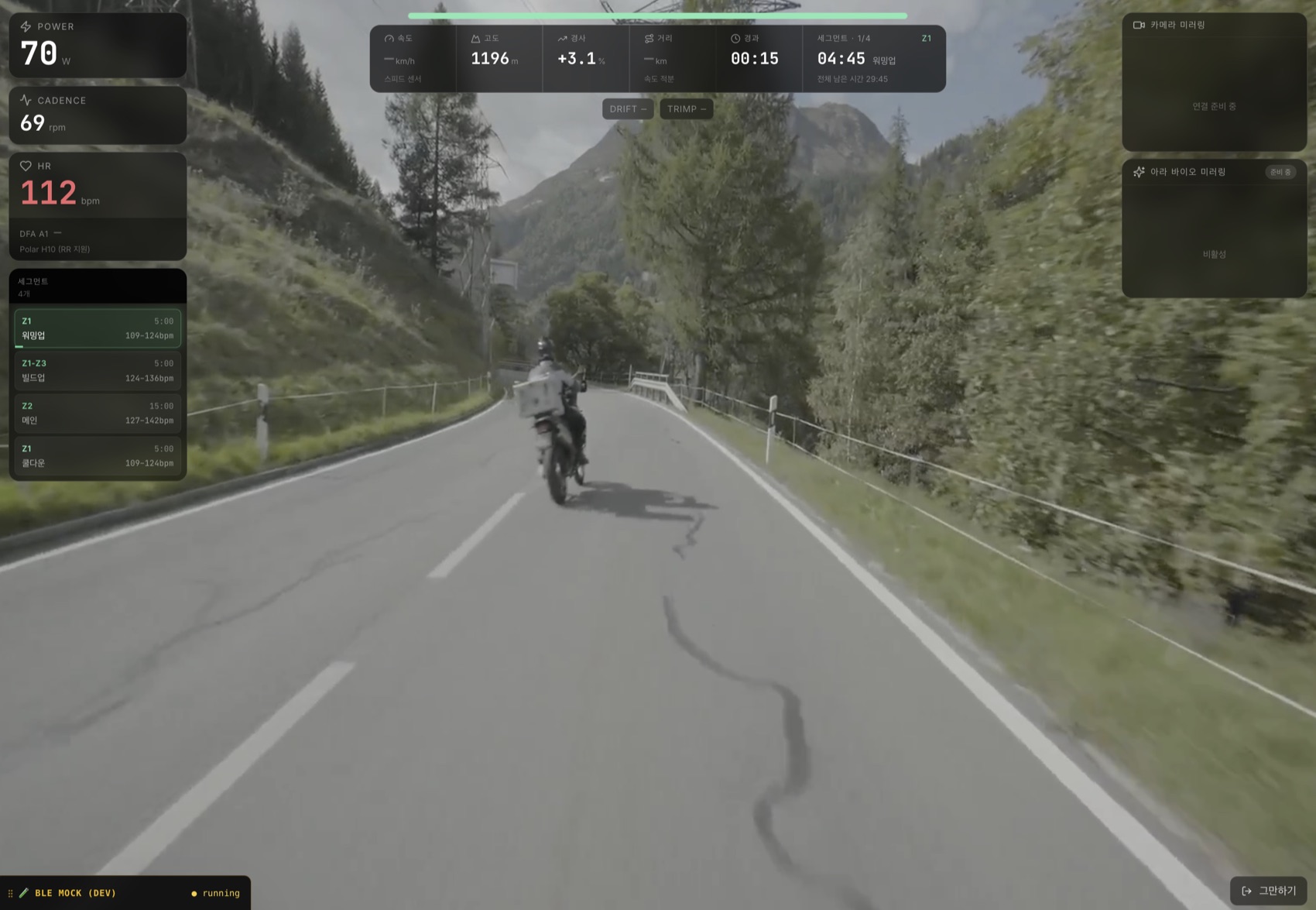
lifeGmap's workout HUD is not a screen wrapped around a fitness API — it is an execution engine that connects execution state, BLE sensors, heart rate / cadence / power, voice cues, and pain checks within a single session.
Safety comes before cleverness.
Every AI response passes through a safety checkpoint (A6 Compliance Guard) before it reaches the user.
Expressions that could be mistaken for medical practice are filtered by Step 1 Python rules → Step 2 Gemini Flash review.
We remove per-user injury-contraindicated exercises, and in dangerous body states (H4) we block the plan itself.
If something goes wrong, a single one-line flag reverts instantly to the last stable version.
lifeGmap does not diagnose, prescribe, or treat, and refers medical judgment to qualified professionals.
In the end, we set out to prove one thing —
long-term retention, all the way to 100.
Structured data, deterministic engines, the knowledge graph, real-time coaching, safety checks — every piece of technology here exists for one thing: to keep you healthy longer, and so to keep you with us longer. Data collection → AI interpretation → personalized plan → habit feedback, then back to data — the more this loop turns, the better the fit, and the longer the subscription lasts.
.fit upload → asynchronous (202) → Kafka pipeline. Writes across the 3 DBs are atomically tracked with session_write_log.
api-gateway, ai-engine, and admin-gateway are separated to isolate the blast radius of failures.
Expanding on-device inference · Stronger personalization · Privacy-preserving coaching · Multilingual model alignment.